

The Memorial Service
of the Orthodox Church
The Church's prayer for a Christian who has fallen asleep in the Lord
Follow the service in order, or jump to any moment using the navigation above. The small gold note beside a heading opens the parish choir music for that part of the service.
The Panikhida is the memorial service of the Orthodox Church, offered for a Christian who has fallen asleep in the Lord. It is a brief service, usually about half an hour, and it may be served in church, at a funeral home, at the graveside, or in the home of the departed. The Church does not leave her children at death; she goes on praying for them by name, and this service is the form that prayer takes.
A Panikhida is customarily served on the third, ninth, and fortieth days after death, on the anniversary of death, and on the Soul Saturdays appointed through the year, when the whole parish prays together for all its departed. It is also served on the eve of a funeral.
The form is ancient. The Apostolic Constitutions, a church order compiled about the year 380, already direct that the departed be remembered on the third, ninth, and fortieth days with psalms and prayers. The service itself is a condensed form of the funeral Matins, and it closes as memorials have closed for centuries, with the singing of Memory Eternal.
The hymns of the service do not pretend that grief is not real. They set grief inside the Resurrection. The same service that says all we mortals return to the earth answers itself at once with the song the Church sings beside every grave: Alleluia.
The word Panikhida comes from the Greek pannychis, an all-night watch. The first Christians kept vigil through the night at the tombs of the martyrs, and prayer beside the dead is among the oldest recorded practices of the Church.
The Order of the
Panikhida
From the opening blessing to Memory Eternal, one unbroken intercession
The Opening Prayers
The priest begins, "Blessed is our God," and the people take up the prayers that open nearly every Orthodox service: the Trisagion, "Holy God, Holy Mighty, Holy Immortal," and the Lord's Prayer. Grief is not given a special language. It is placed inside the Church's ordinary prayer, and the words Holy Immortal confess the deathless God before the fact of death.
Glory to the Father, and to the Son, and to the Holy Spirit, now and ever, and unto ages of ages. Amen.
O Most Holy Trinity, have mercy on us. O Lord, cleanse us from our sins. O Master, pardon our transgressions. O Holy One, visit and heal our infirmities, for Thy Name’s sake.
Lord, have mercy. 3x
Glory to the Father, and to the Son, and to the Holy Spirit, now and ever, and unto ages of ages. Amen.
Our Father, Who art in heaven, hallowed be Thy Name; Thy Kingdom come; Thy will be done, on earth as it is in heaven. Give us this day our daily bread, and forgive us our trespasses, as we forgive those who trespass against us; and lead us not into temptation, but deliver us from evil.
Grief is not given a special language. It is placed inside the Church's ordinary prayer, and the words Holy Immortal confess the deathless God before the fact of death.
Psalm 90
Refuge under the wings of the AlmightyThe reader takes up Psalm 90: "He that dwelleth in the help of the Most High." Its images are all shelter: wings, a shield, angels given charge, deliverance from the terror by night. The Church reads it over her departed to entrust them to the protection that continues where ours has ended, and the psalm closes in God's own voice: "I will show him My salvation."
He who dwells in the secret place of the Most High
shall abide under the shadow of the Almighty.
I will say of the Lord, “He is my refuge and my fortress;
my God, in Him I will trust.”
Surely He shall deliver you from the snare of the fowler
and from the perilous pestilence.
He shall cover you with His feathers,
and under His wings you shall take refuge;
His truth shall be your shield and buckler.
You shall not be afraid of the terror by night,
nor of the arrow that flies by day,
Nor of the pestilence that walks in darkness,
nor of the destruction that lays waste at noonday.
A thousand may fall at your side,
and ten thousand at your right hand;
but it shall not come near you.
Only with your eyes shall you look,
and see the reward of the wicked.
Because you have made the Lord, who is my refuge,
even the Most High, your habitation,
No evil shall befall you,
nor shall any plague come near your dwelling;
For He shall give His angels charge over you,
to keep you in all your ways.
They shall bear you up in their hands,
lest you dash your foot against a stone.
You shall tread upon the lion and the cobra,
the young lion and the serpent you shall trample under foot.
“Because he has set his love upon Me,
therefore I will deliver him;
I will set him on high, because he has known My name.
He shall call upon Me, and I will answer him;
I will be with him in trouble;
I will deliver him and honor him.
With long life I will satisfy him,
and show him My salvation.”
Glory to the Father, and to the Son, and to the Holy Spirit,
now and ever, and unto ages of ages. Amen.
Alleluia! Alleluia! Alleluia! Glory to Thee, O God. 3x
The psalm ends with God Himself speaking: "He shall call upon Me, and I will answer him... and show him My salvation." The Church reads that promise over her departed.
The Great Litany
The litany that opens the Divine Liturgy opens here as well: "In peace, let us pray to the Lord." But every petition after the first is for the departed: for their repose, for the pardon of every transgression, voluntary and involuntary, for "a place of brightness, a place of refreshment, a place of rest." The daily needs of the living give way, for this hour, to the need of one soul.
Lord, have mercy, in Greek Kyrie, eleison, is the people's oldest recorded answer in Christian worship: church orders of the fourth century already show a deacon chanting petitions and the congregation responding with these words.
The Alleluia
Where Matins would sing the festal "God is the Lord," the memorial service sings Alleluia, with verses: "Blessed are they whom Thou hast chosen and taken, O Lord." The same substitution marks the weekdays of Great Lent. Both point away from present festivity toward the age to come, and the Church's first sung word over death is praise.
The Alleluia is not an interruption of grief but the Church's answer to it. The same word of praise that rings at Pascha is sung beside every grave, because Christ has trampled down death by death.
The Troparion
The choir sings, "Thou only Creator Who, with wisdom profound, mercifully orderest all things." The hymn echoes St. Paul: "O the depth of the riches both of the wisdom and knowledge of God" (Romans 11:33). Nothing, not even this death, falls outside God's loving ordering of the world, and the plea for rest stands not on the merits of the departed but on their hope in the One who fashioned them.
The plea for rest stands not on the merits of the departed but on their hope in the One who fashioned them: "our Maker and Fashioner, and our God."
The Evlogitaria
Between refrains of Psalm 118, "Blessed art Thou, O Lord, teach me Thy statutes," the choir sings the hymns of the departed: "The choir of the saints have found the fountain of life," and "I am the image of Thine ineffable glory, though I bear the brands of transgressions." Sunday Matins sings a twin set of these hymns for the Resurrection. The funeral set is their mirror, asking that Pascha reach this soul.
The Evlogitaria are written in the first person: "I am a lost sheep: call me, O Savior." The Church lends her voice to the one who has died, and the departed, through the choir, makes one last confession of hope.
The Little Litany
"Again and again, in peace let us pray to the Lord." The little litany returns throughout the service, after the Evlogitaria and between the odes of the canon, always with the same two petitions: forgiveness of every transgression, and a place where the righteous repose. The service does not move past intercession; it keeps returning to it.
The little litany returns between the odes of the canon, always with the same two petitions: forgiveness of every transgression, and a place where the righteous repose.
Give Rest with the Just
This short hymn is a sedalen, literally a "sitting hymn," sung at the point in Matins where the faithful were permitted to sit after long psalmody. It prays that God settle His servants in His courts, "according as it is written," and the written word it reaches for is the Alleluia's own psalm: "Blessed is he whom Thou hast chosen and taken; he shall dwell in Thy courts."
The hymn quotes the psalm the service has already sung: "Blessed is he whom Thou hast chosen and taken; he shall dwell in Thy courts."
Psalm 50
Mercy is the ground of every petitionDavid's psalm of repentance, "Have mercy on me, O God," is the most often prayed psalm in Orthodox worship, and it stands here before the canon. Before the Church dares her longest intercession for the departed, she confesses that mercy, not merit, is the ground on which anyone, living or dead, stands before God.
Have mercy upon me, O God,
according to Thy lovingkindness;
According to the multitude of Thy tender mercies,
blot out my transgressions.
Wash me thoroughly from my iniquity,
and cleanse me from my sin.
For I acknowledge my transgressions,
and my sin is ever before me.
Against Thee, Thee only, have I sinned,
and done this evil in Thy sight,
That Thou mayest be found just when Thou speakest,
and blameless when Thou judgest.
Behold, I was brought forth in iniquity,
and in sin did my mother conceive me.
Behold, Thou desirest truth in the inward parts,
and in the hidden part Thou shalt make me to know wisdom.
Purge me with hyssop, and I shall be clean;
wash me, and I shall be whiter than snow.
Make me to hear joy and gladness,
that the bones which Thou hast broken may rejoice.
Hide Thy face from my sins,
and blot out all my iniquities.
Create in me a clean heart, O God,
and renew a steadfast spirit within me.
Cast me not away from Thy presence,
and take not Thy Holy Spirit from me.
Restore unto me the joy of Thy salvation,
and uphold me with Thy generous Spirit.
Then will I teach transgressors Thy ways,
and sinners shall be converted unto Thee.
Deliver me from bloodguiltiness, O God,
Thou God of my salvation,
and my tongue shall sing aloud of Thy righteousness.
O Lord, open Thou my lips,
and my mouth shall show forth Thy praise.
For Thou desirest not sacrifice, else would I give it;
Thou delightest not in burnt offering.
The sacrifices of God are a broken spirit;
a broken and a contrite heart, O God, Thou wilt not despise.
Do good in Thy good pleasure unto Zion;
build Thou the walls of Jerusalem.
Then shalt Thou be pleased with the sacrifices of righteousness,
with burnt offering and whole burnt offering;
Then shall they offer bulls upon Thine altar.
Before the Church dares her longest intercession for the departed, she confesses that mercy, not merit, is the ground on which anyone, living or dead, stands before God.
The Canon
The Church sings the departed toward restA canon is a chain of sung poetry built on the great songs of Scripture, and the irmos that opens each ode ties it to its biblical song. The Panikhida takes the canon for the departed in a shortened form, the composition of St. Theophanes the Branded, with one refrain returning throughout: "Give rest, O Lord, to the souls of Thy servants."
Irmos of the First Ode
After the irmos, the priest intones the verses, and the people answer with the refrains below.
The Refrains of the Canon
Irmos of the Third Ode
Irmos of the Sixth Ode
A canon is a chain of sung poetry built on the great songs of Scripture. The irmos that opens each ode ties it to its biblical song.
Kontakion and Ikos
"With the saints give rest, O Christ, where sickness and sorrow are no more, neither sighing, but life everlasting." These lines are the surviving head of an ancient kontakion, a sung sermon, and they are heard at every Orthodox funeral and memorial. The Ikos answers with Genesis itself, "dust thou art, and unto dust shalt thou return," and then turns even that sentence into a song: Alleluia.
Irmos of the Ninth Ode
The refrains are sung once more, and the choir concludes the canon with the irmos of the ninth ode, the ode of the Mother of God.
The melody of "With the saints give rest" has traveled far beyond Orthodox walls: it was sung at the funerals of Sir Winston Churchill, Prince Philip, and Queen Elizabeth II.
The Trisagion Prayers
Near the end, the service returns to its own beginning: "Holy God," the prayers to the Trinity, the Lord's Prayer. Everything that follows, from these prayers to Memory Eternal, is also served by itself at the graveside, where it is called simply the Trisagion. The longest memorial and the shortest end the same way.
Holy God, Holy Mighty, Holy Immortal, have mercy on us. 3x
Glory to the Father, and to the Son, and to the Holy Spirit, now and ever, and unto ages of ages. Amen.
O Most Holy Trinity, have mercy on us. O Lord, cleanse us from our sins. O Master, pardon our transgressions. O Holy One, visit and heal our infirmities, for Thy Name’s sake.
Lord, have mercy. 3x
Glory to the Father, and to the Son, and to the Holy Spirit, now and ever, and unto ages of ages. Amen.
Our Father, Who art in heaven, hallowed be Thy Name; Thy Kingdom come; Thy will be done, on earth as it is in heaven. Give us this day our daily bread, and forgive us our trespasses, as we forgive those who trespass against us; and lead us not into temptation, but deliver us from evil.
Tradition holds that during an earthquake in Constantinople a boy was caught up and heard the angels singing, Holy God, Holy Mighty, Holy Immortal; the people took up the hymn, and the shaking ceased. The assembled bishops sang the Trisagion at the Council of Chalcedon in the year 451.
With the Souls
of the Righteous
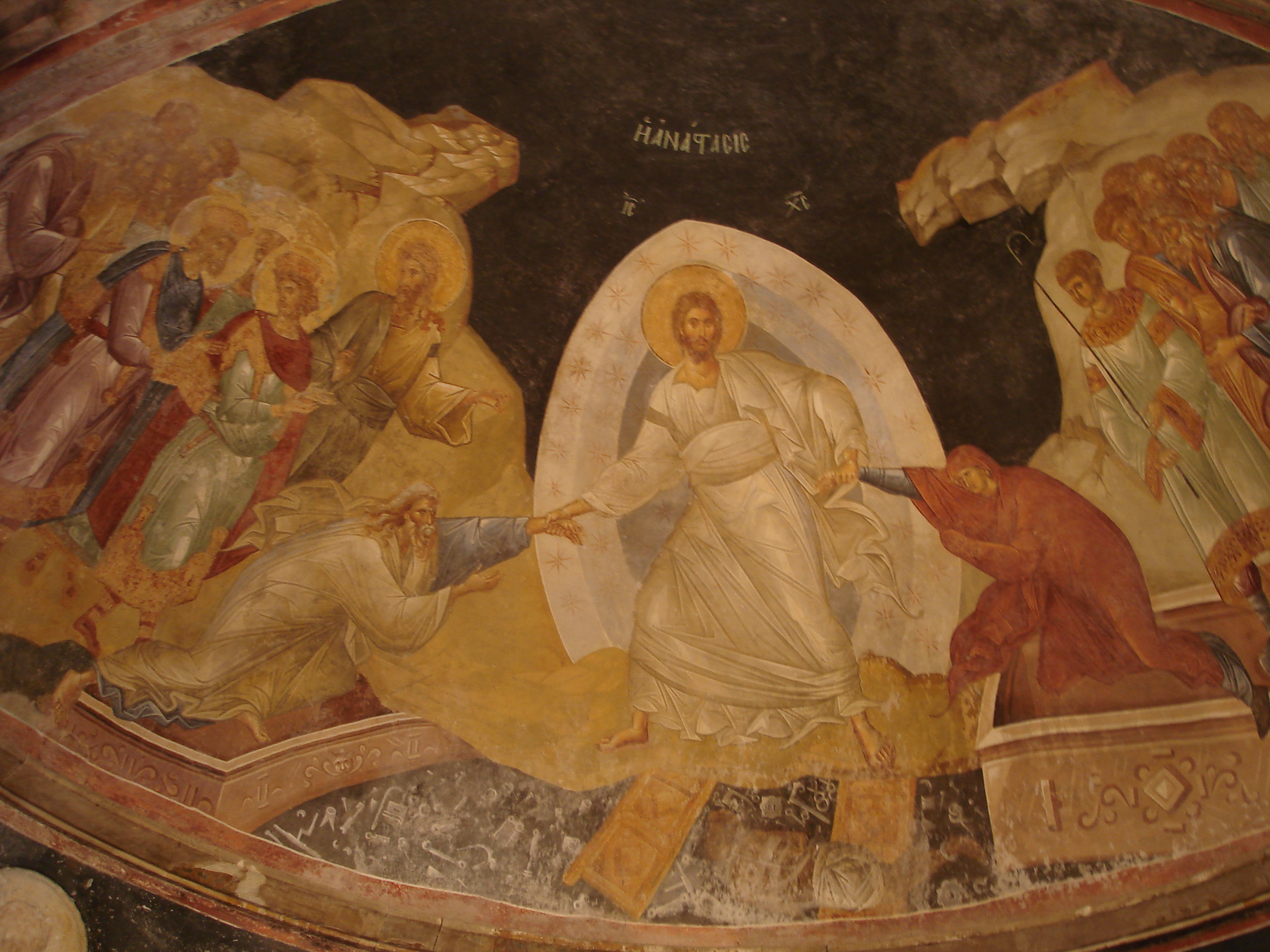
Four brief hymns ask one thing from four sides: "With the souls of the righteous departed, give rest, O Savior, to the soul of Thy servant." They pass from the single soul to the company of the saints, to Christ who descended into hades and loosed the chains of the captives, and last to the Mother of God, asked to intercede. The whole service is in them in miniature.
On the Great and Holy Sabbath, Christ rested in the tomb, and so Saturday became the Church's weekly day of prayer for all who rest in Him. Several Saturdays each year are kept as Soul Saturdays.
The Litany
for the Departed
The priest asks rest for the departed by name, and prays the prayer the whole service has been circling: "O God of spirits and of all flesh, Who hast trampled down death." The address is Moses' own (Numbers 16:22), and the exclamation is Christ's word at the tomb of Lazarus: "For Thou art the Resurrection, and the Life."
O God of spirits, and of all flesh, Who hast trampled down Death, and overthrown the Devil, and given life unto Thy world: do Thou, the same Lord, give rest to the soul(s) of Thy departed servant(s), , in a place of brightness, a place of refreshment, a place of repose, where all sickness, sorrow, and sighing have fled away. Pardon every transgression which he (she, they) hath committed, whether by word, or deed, or thought.
For Thou art a good God, and lovest mankind; because there is no man who lives and sins not; for Thou only art without sin, and Thy righteousness is to all eternity, and Thy Word is true.
The prayer "O God of spirits and of all flesh" stands in the oldest surviving Byzantine service book, the Barberini Euchologion of the 700s, and on a papyrus written about the year 600. A mourner praying it tonight prays in the company of fourteen centuries.
The Dismissal
Even at a memorial the dismissal begins, "May Christ our true God, Who rose from the dead." The Church will not speak of death without first naming the Resurrection. The departed are commemorated by name, and the prayer asks that their souls be established in the mansions of the righteous.
The Church will not speak of death without first naming the Resurrection. The departed are commemorated by name, and the prayer asks that their souls be established in the mansions of the righteous.
Memory Eternal
The choir sings Memory Eternal three times, slowly, while the priest censes. The petition is not that we remember, though we will. It asks that God remember, for in Scripture it is God's remembering that keeps a man alive. It is the counterpart of the Many Years sung for the living.
Dostoevsky ends The Brothers Karamazov inside this prayer: at the memorial meal for the boy Ilyusha, Alyosha and the boys take up the cry, Memory Eternal.
When the Panikhida Is Served
The third, the ninth, and the fortieth dayMemorials are offered on the third day after death, for the Lord rose on the third day; on the ninth, that the soul may be joined to the nine ranks of angels; and on the fortieth, recalling the forty days of mourning for Moses and the forty days from Pascha to the Ascension. After that, the Church remembers the departed each year on the anniversary of their falling asleep.
On the Great and Holy Sabbath, Christ rested in the tomb, and so Saturday became the Church's weekly day of prayer for all who rest in Him. Several Saturdays each year are kept as Soul Saturdays, when the whole parish serves this memorial for all its departed together. A Panikhida may also be requested at any time: speak with Fr. Solomon to arrange one, and give the names of your departed to the priest before the service begins, written if possible.
Kolyva: The Blessed Wheat
The Lord's own image of the ResurrectionA dish of kolyva, boiled wheat sweetened with honey, is often set out at a Panikhida with a candle burning in it. The wheat is the Lord's own image of the Resurrection: unless a grain of wheat falls into the earth and dies, it remains alone, but if it dies, it bears much fruit. The candle burning in the wheat speaks the same hope, the light of Christ, which the darkness has not overcome.
You may bring kolyva to a memorial for your own departed; it is blessed during the service and shared afterward in their memory. The custom has its own feast day: in the year 362, the story is told, the emperor Julian the Apostate ordered the food of the markets defiled with idol offerings in the first week of Great Lent, and the martyr Theodore the Recruit appeared in a vision to the city's archbishop and told the Christians to eat only boiled wheat. The Church still blesses kolyva on the first Saturday of Great Lent, and beside her departed.
Pray for Your Departed
Panikhidas are served on Soul Saturdays, on anniversaries, and by request. Give the names of your departed to Fr. Solomon before the service begins, written if possible. You may also bring kolyva to be blessed.