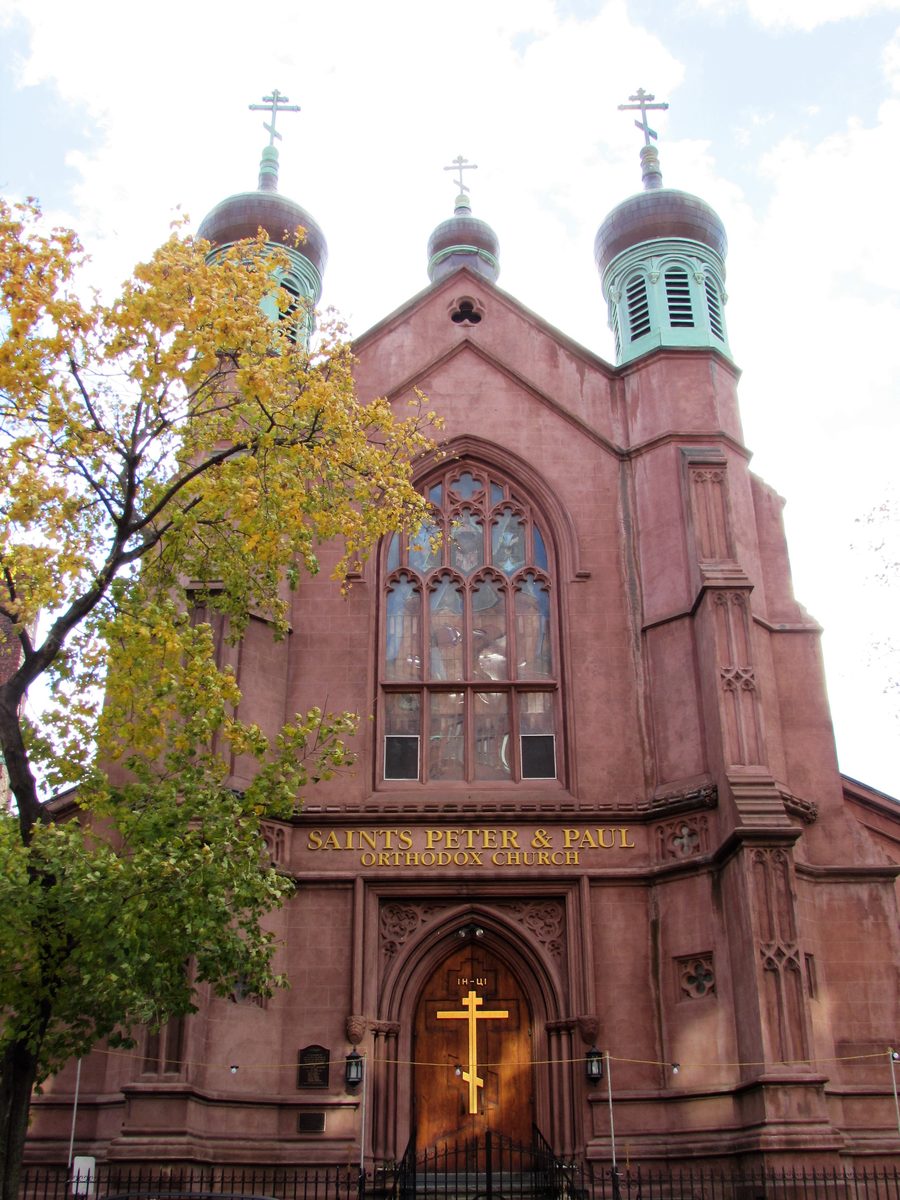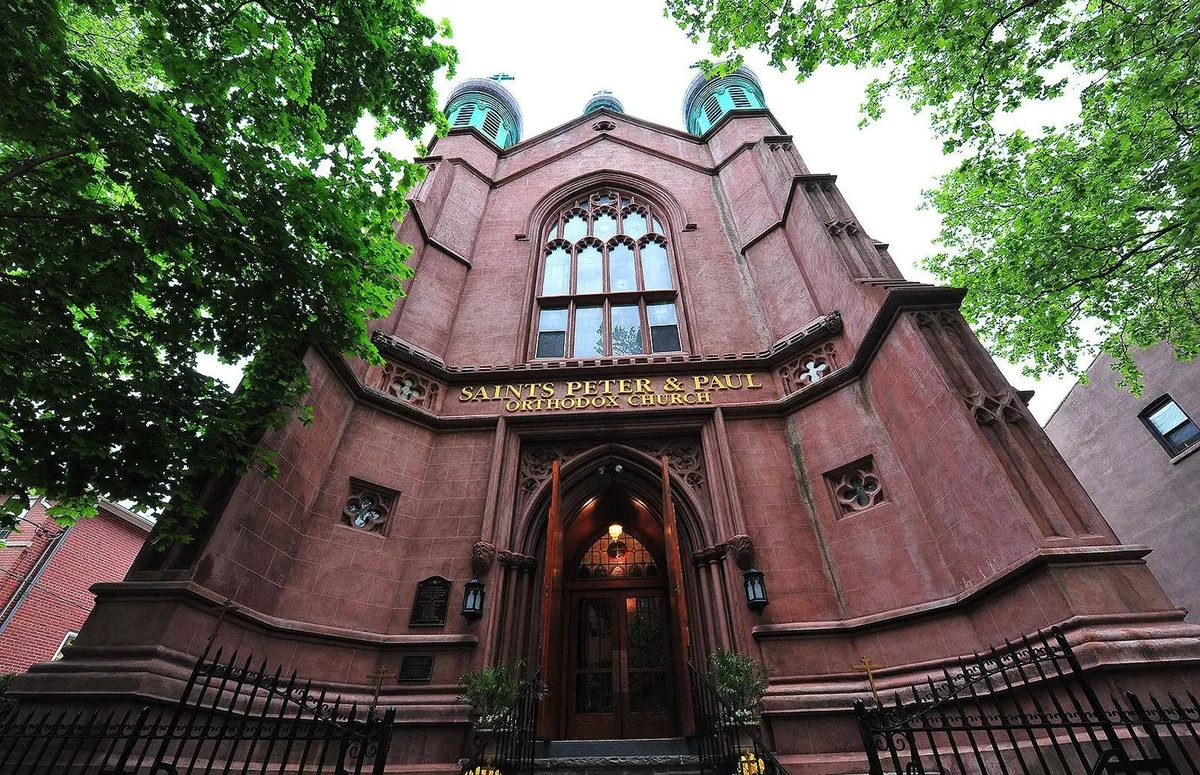
Saints Peter and Paul Orthodox Cathedral on Grand Street is the second oldest Slavic Orthodox parish in New Jersey, founded in 1907 by Eastern European immigrants who had chosen the ancient Byzantine faith over the accommodations being demanded of them by local Roman Catholic bishops. Its congregation belongs to the self-governing Orthodox Church in America, under the Diocese of New York and New Jersey. The building stands as a Contributing Resource of the Paulus Hook Historic District, listed on the State and National Register of Historic Places since 1982.
For more than two centuries, this corner of Grand Street has been reserved exclusively for worship. The parish's story begins decades before Orthodoxy arrived here: in the swampy undeveloped frontier of Paulus Hook.
Saints Peter & Paul Orthodox Cathedral is a Contributing Resource of the Paulus Hook Historic District on the State and National Register of Historic Places (1982), and received matching grants from the New Jersey Historic Trust for its landmark restoration.
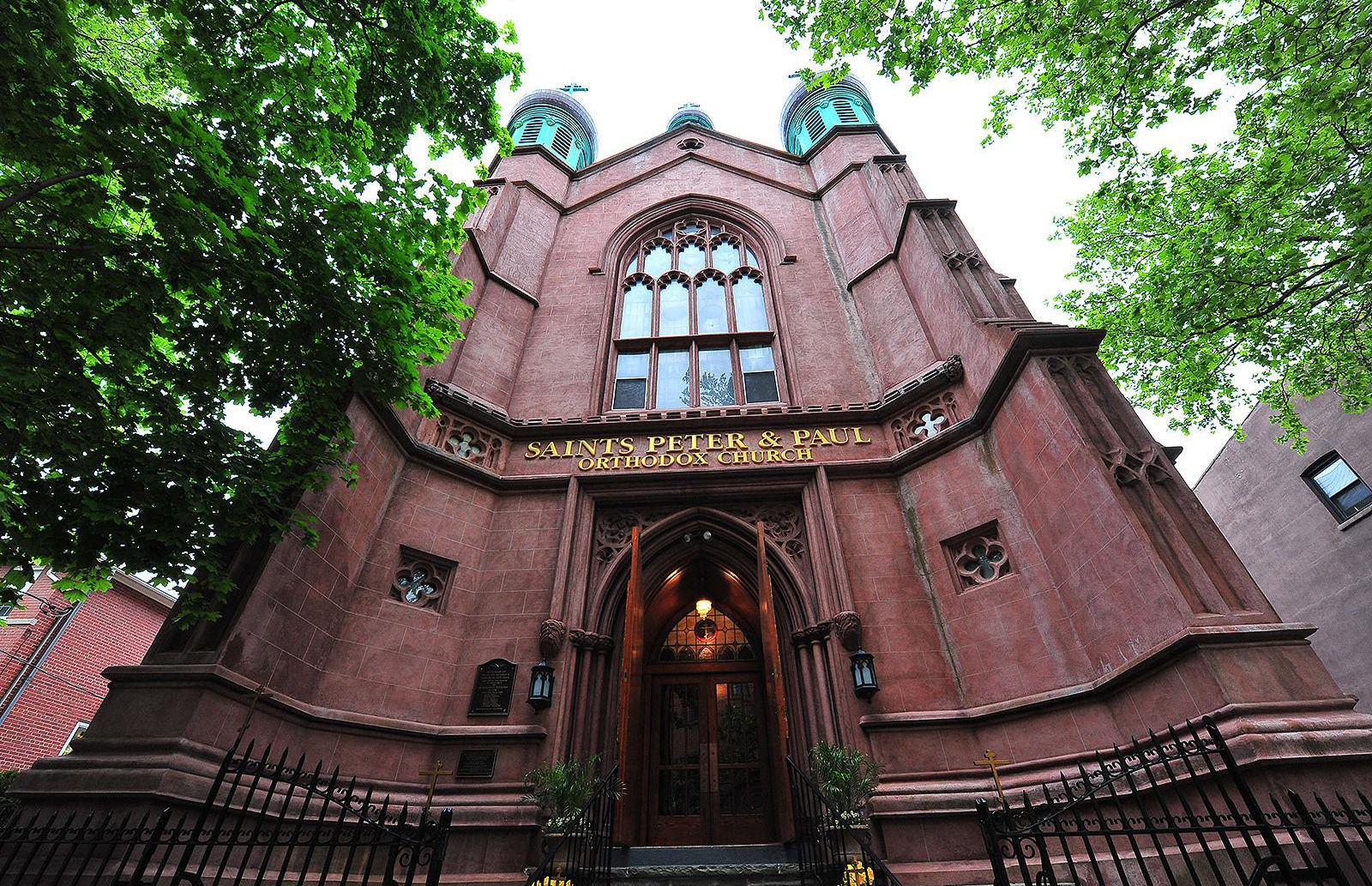
The Gothic Revival façade of Saints Peter & Paul, 109 Grand Street, Jersey City, a Contributing Resource of the Paulus Hook Historic District since 1982.
Paulus Hook Origins
The provenance of the church lot dates to the Associates of the Jersey Company, a development corporation formed for Paulus Hook in 1804. Its leading investors (New York Federalists Anthony Dey, Jacob Radcliffe, Richard Varick, and their attorney Alexander Hamilton, among others) were merchants and lawyers intent on transforming the farms and marshlands of Paulus Hook into a prosperous community. They leased the swampy, frontier-like Hudson River waterfront property from Cornelius Van Vorst (1728–1818), a descendant of the site's early seventeenth-century Dutch proprietor.
The Jersey Company commissioned surveyor Joseph F. Mangin to map the tract, dividing it into 200-by-400-foot blocks and subdividing those into 1,344 lots of 25-by-100 feet, most of which were underwater. One thousand shares were offered to prospective buyers to raise revenue for the project.
Joseph F. Mangin's survey of Paulus Hook, 1804, showing the four lots designated "church grounds", the only sites named on the original map.
Cornelius Van Vorst (1728–1818), descendant of Paulus Hook's early Dutch proprietors, leased the waterfront tract to the Associates of the Jersey Company in 1804.
Among the incentives to attract settlement was a striking designation: at the highest and driest point of the survey, four lots were marked "church grounds", the only sites named on the original map. As historian Barbara Petrick explains, the original proprietors assumed it was the churches that would provide the anchor of civilization, bringing schools and the formation of decent citizens in their wake.
Four churches were eventually established on the donated properties, though the area's population grew more slowly than the Associates had anticipated. St. Matthew's Protestant Episcopal Church, organized in 1808, was the first to take advantage of the offer, installing its cornerstone in 1831. Saint Peter's Roman Catholic Church began that same year on Grand Street, and the Methodists built a brick church on York Street by 1843.
Church Development on Grand Street
In 1807, the Associates approached members of the Dutch Reformed Church at Bergen Hill to build on the south side of Grand Street. The offer was declined for want of sufficient male members to form a Consistory. The Associates then offered the lot to Presbyterians, who in 1826 laid a cornerstone for a wooden church, the First Presbyterian Church, capable of accommodating 400 parishioners.
The New York Times described the Grand Street property at the time: the ground was all swamp, and the church stood upon 500 piles. Flooding repeatedly threatened the structure, and Dutch farmers of the district reportedly saved it on at least one occasion by hauling fresh earth to bury the exposed piles beneath their carts.
The First Presbyterian Church on Grand Street was short-lived. A change of church affiliation in 1830 converted the congregation to Dutch Reformed. The Grand Street Church, as it was commonly known, never completed the stone structure required under the Associates' agreement, and struggled with unstable leadership and finances for years. A separate First Presbyterian Church was eventually established in 1844 at Sussex and Washington Streets.
On September 22, 1853, the Dutch Reformed Church installed a cornerstone on Grand Street for a cut-stone Gothic Revival church to replace the wooden structure, built on a lot then adjacent to Lyceum Hall, which had served as the first Hudson County courthouse until 1843. Among the items placed in the cornerstone's cavity were the psalms of the Reformed Dutch Church and its constitution.
The first architect engaged for the project was Scottish-born John W. Welch (1824–1894) of Brooklyn, known for the landmark St. Luke's Protestant Episcopal Church in his hometown and Eberhardt Hall at what is now the New Jersey Institute of Technology. A dispute with Welch and cost overages of more than the intended $20,000 left the building with only its outer walls and required the engagement of a new architect.
The New York Times identified the new architect as "Mr. M. Lineau, of Jersey City": in all likelihood Detlef Lienau (1818–1887), born in Denmark's region that later became part of Germany. Trained in Germany and Paris, Lienau immigrated to America to join his brother Michael in Jersey City, becoming one of the founders of the American Institute of Architects. His Jersey City work included Grace Church Van Vorst at 39 Erie Street (1850), the Mechanics and Traders Bank Building (1859), the original First National Bank building at One Exchange Place (1864), and the American Sugar Refinery at 174 Washington Street (1863).
The completed Dutch Reformed Church, dedicated April 5, 1857, was described by the Times as built of brown sandstone from Belleville and Little Falls in "perpendicular Gothic of the Twentieth Century." Its nave stretched 48 feet high and 30 feet wide beneath an open-timbered roof. The 106-by-70-foot structure held ten stained-glass windows, 128 pews for 750 persons, gas lights, and ten arches on eight columns. Final costs doubled the original estimate, making it the most expensive church then standing in Jersey City.
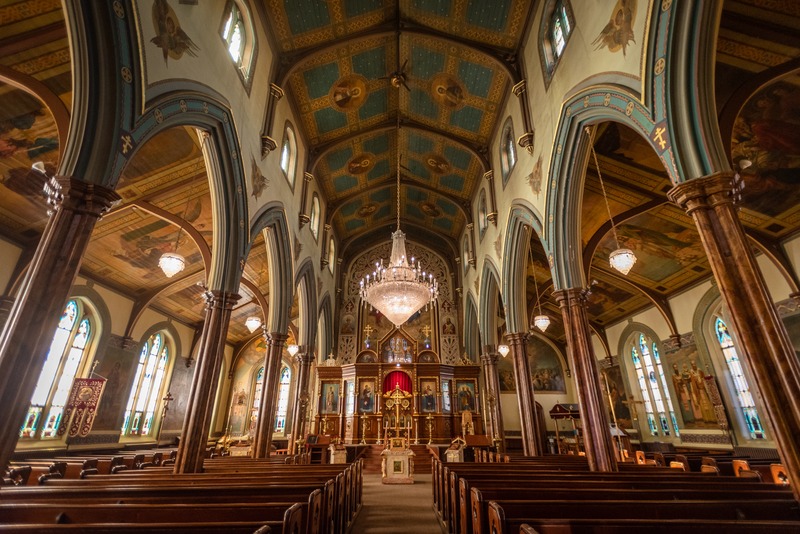
Lienau's 1857 frame survives in the nave today: ten arches on eight columns, an open-timbered roof, and ten stained-glass windows, built for a congregation of 750.
The First Liturgy and the First Transformation, 1907–1919
By the 1870s, Jersey City's population surged with immigration and industrialization. Political consolidation in 1870, three major railway lines, and employment at Colgate, the Great Atlantic & Pacific Tea Company, P. Lorillard Tobacco, American Sugar Refining, and Dixon Crucible drew newcomers in waves. The population climbed from 82,000 to 200,000 by 1900, a scale of growth the Associates of the Jersey Company could not have imagined when they platted these blocks in a swamp.
Eastern European immigrants from Slovakia, Ukraine, and the Russian Empire arrived in Jersey City in the late nineteenth century, drawn by work at the city's railroads and refineries. By 1900 the population had reached 200,000.

St. Alexander Hotovitsky, first rector of Saints Peter and Paul, 1907. Canonized 1994.
Among the new arrivals were Eastern Europeans from what is now Slovakia and Ukraine, and from the Russian Empire. They organized the Saints Peter and Paul Brotherhood under a December 1889 charter, initially gathering in a wooden building on Chestnut Street. By 1902, the congregation had moved into a newly constructed brick church at the southeast corner of Greene and Sussex Streets, worshipping as Eastern Rite Catholics under the Byzantine liturgical rite.
When pressure mounted to replace the Byzantine rite with more Latinized forms of worship, approximately 500 congregants withdrew. They would not surrender the ancient traditions their families had carried from the old country. Drawn to the growing Russian Orthodox movement in North America, they held services first at 74 Grand Street in the former annex of Public School No. 1, then in a series of rented house churches: 131 Grand Street, then 64 Grand Street at $35.00 per month.
On February 16, 1907, the congregation incorporated as "Saints Peter and Paul Russian Orthodox Greek Catholic Church of Jersey City." They petitioned Archbishop Platon of New York for reception into the Russian Orthodox Church of America, and on October 24, 1907, Archpriest Alexander Hotovitsky led the parish's first Divine Liturgy at his 64 Grand Street residence. A community of faith had come home to Grand Street.

The sandstone Gothic Revival church on Grand Street, purchased by the Archdiocese in 1909 for $35,000.
In 1908, the Archdiocese assigned Rev. Alexander Nemolovsky as the first permanent resident rector, living at 131 Grand Street on $25 per month. Within a year, the congregation had outgrown its rented rooms. In February 1909, the Russian Orthodox Archdiocese in America purchased the former First Reformed Church on Grand Street for $35,000 from the Collegiate Reformed Church of New York City, which had held the mortgage since the 1850s. The Gothic Revival sandstone church that the Dutch Reformed had built on this lot in 1857 would now become an Orthodox cathedral.
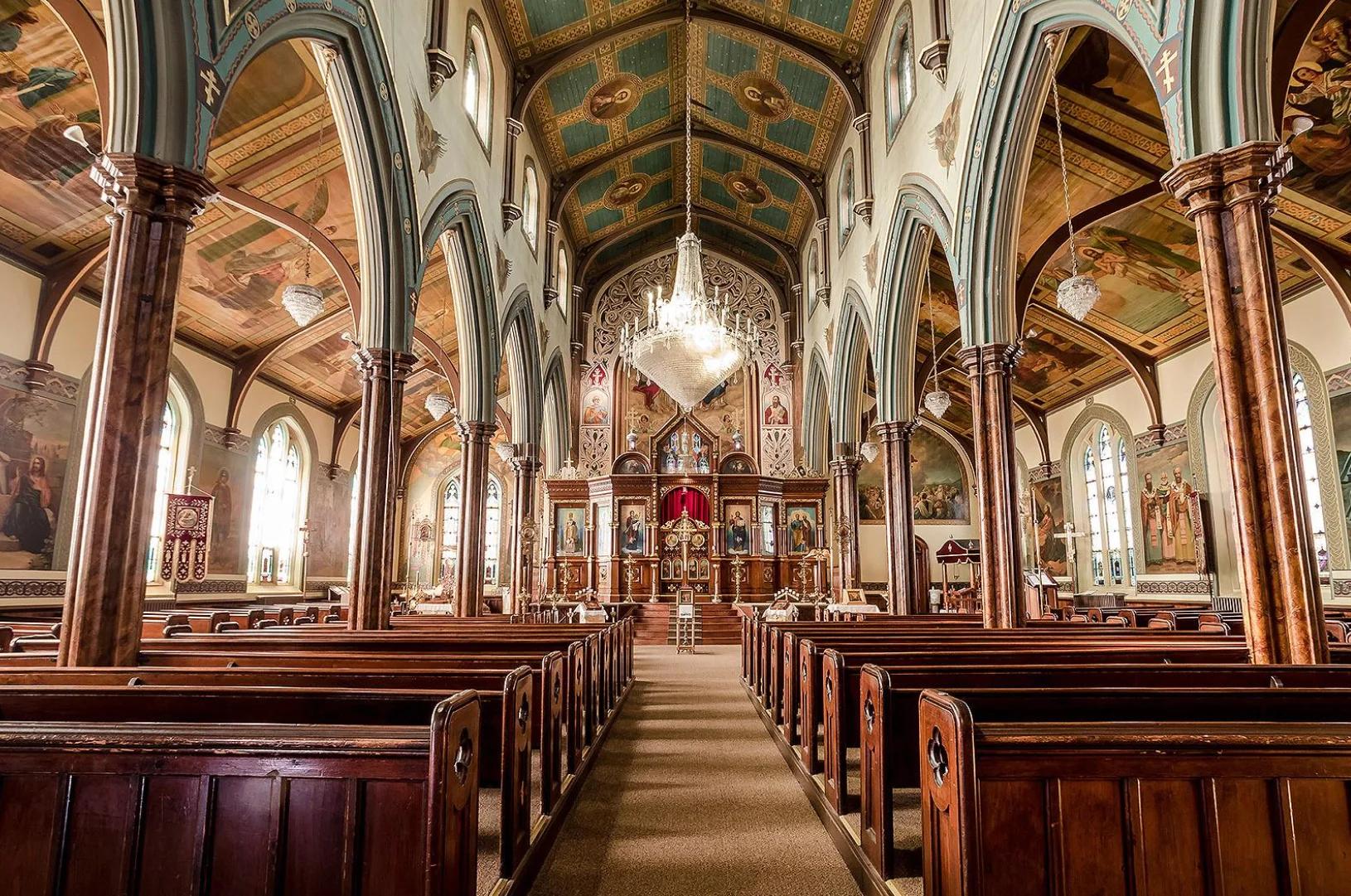
The Royal Doors and Iconostasis, purchased in 1909 for $1,200.
With the parish's formal incorporation on August 31, 1909, work began to transform the Gothic Revival structure into a space fitting for the celebration of the Orthodox liturgy. On July 7, 1909, a hand-carved solid oak Iconostasis was purchased for $1,200. Its center Royal Doors with icons and red curtains were modeled after those at Saint Nicholas Cathedral in New York City, and its oil-painted icons on canvas were imported from Russia.
The Iconostasis, set on a platform reached by stairs, divides the altar from the nave, performing a multi-faceted symbolic role, sometimes emphasizing the division and sometimes the unity of the heavenly and earthly, the divine and the human. An icon of the Last Supper appears over the Royal Doors. The Table of Oblation, to the left of the Iconostasis, holds sacred vessels for the Holy Eucharist.
The hand-carved solid oak Iconostasis, purchased in 1909 for $1,200 and modeled after Saint Nicholas Cathedral in New York City. Oil-painted icons on canvas were imported from Russia. The Royal Doors at center are flanked by icons and hung with red curtains.
"Images or icons are silent sermons uttered in color. A wall of icons, the iconostasis, displays saints including Saint Nicholas, a fourth century bishop. Beyond the wall is the sacred inner space of the altar, or Holy of Holies."
Rev. Joseph Lickwar, Rector 1991–2023 · Jersey City's Sacred Spaces, 2004
The three Russian-style copper domes rising above Grand Street. Photo by Daniel E. Beards.
The exterior was transformed alongside the interior. The two corner towers, capped originally in the Gothic style, were crowned with three Russian-style cupolas, copper domes, and Orthodox three-bar crosses. What the Dutch Reformed had built as a cut-stone Gothic sanctuary was now unmistakably an Orthodox church, its domes visible across the rooftops of Paulus Hook.
The first two men to serve this parish left marks on American Orthodoxy that reach far beyond Grand Street. Archpriest Alexander Hotovitsky served here only through the parish's founding year, yet his name is now in the calendar of saints. After his work in North America, he returned to Russia, where the Bolsheviks arrested him, and where he was shot in August 1937 after enduring years of imprisonment and labor camps. The Russian Orthodox Church canonized him in 1994 as a New Martyr and Confessor of Russia.
Alexander Nemolovsky served as the first permanent rector from 1908 to 1909. Within months of arriving in Jersey City, he supervised the purchase of this building, obtained the hand-carved oak iconostasis, and signed the parish's Certificate of Incorporation in August 1909. The Holy Synod then elected him the first vicar bishop of the North American Archdiocese, and he was consecrated Bishop of Sitka at the Alexander Nevsky Lavra in St. Petersburg on November 15, 1909, by five bishops who would go on to lead different Orthodox jurisdictions across the following century.
In February 1919, at St. Theodosius Cathedral in Cleveland, Nemolovsky was elected Archbishop of the Aleutians and North America by the Second All-American Sobor. It was the first election of an Orthodox primate by clergy and laity together in the Western Hemisphere, and it established the model for every subsequent election of the OCA's primates. The man who had lived on Grand Street for one year, at $25 per month, set the democratic precedent by which the Orthodox Church in America has governed itself ever since.
His later years were no less extraordinary. Appointed Archbishop of Brussels and Belgium in 1936, he was arrested by forty Gestapo officers immediately after Divine Liturgy on November 4, 1940, handcuffed before his congregation, and imprisoned in Berlin for the duration of the war. Released in 1945, he returned to Brussels, established nursing homes for Russian refugees, and served daily liturgy into his eighties. He died on April 11, 1960, the Monday of Holy Week, and was buried at Ixelles Cemetery in Brussels.
The Interior Takes Shape, 1920–1944
Between Nemolovsky's elevation to the episcopate in 1909 and the arrival of the third permanent rector in 1920, at least seven clergymen served the parish. Several held distinguished positions in the broader life of American Orthodoxy: Protopresbyter Peter G. Kohanik, who would spend 44 years as founding rector of St. John the Baptist in Passaic; Mitred Archpriest Joseph O. Dzvonchik, Vice President and Secretary of the Metropolitan Council; and Archpriest Michael Chervinsky, who physically held the bishop's residence against police and lawyers during the 1925 cathedral dispute in New York. These men maintained the community during its first decade on Grand Street.
The third permanent rector, Very Rev. John J. Adamiak, shaped the interior of the church that visitors see today. Born in 1889 in Mayfield, Pennsylvania, he had been sent to seminary in Russia at age fourteen, hand-selected by Bishop Tikhon, the future Patriarch of Moscow. He returned to complete his training in Minneapolis and was ordained in 1911 as one of the first American-born Orthodox priests. He arrived at Saints Peter and Paul in 1920 and remained for twenty years, serving concurrently as Dean of all Orthodox parishes in New Jersey for most of that tenure.
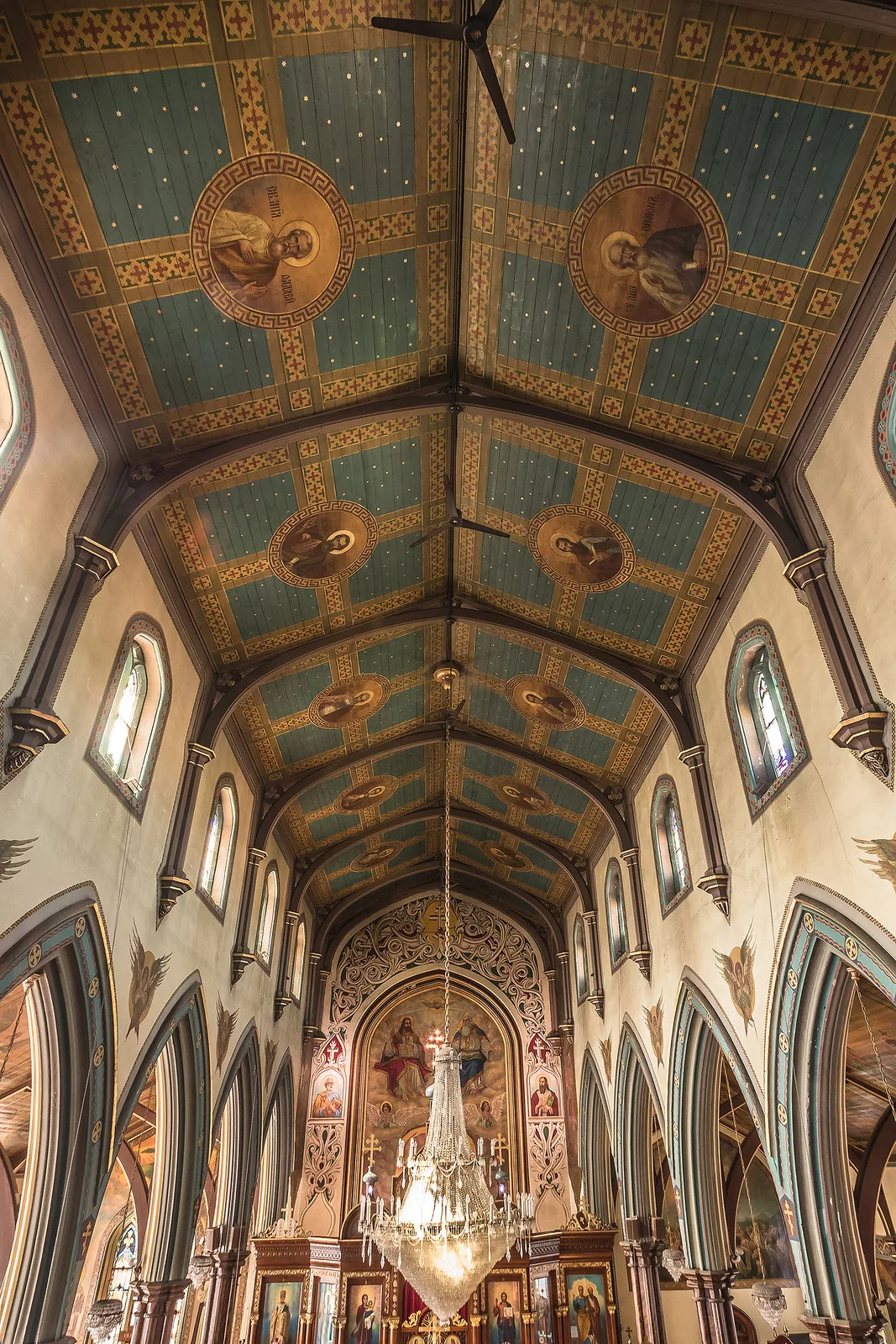
One of 70+ murals by iconographer Photius Bodasiuk of Kiev, completed over three years in the 1920s–1930s.
Father Adamiak's lasting contribution was the commission of Photius Bodasiuk, an iconographer from Kiev who spent three years painting the more than 70 murals that cover the nave ceiling and walls. A new spruce ceiling had modified the former trusses to allow for overhead painting, and Bodasiuk filled that space with images that transformed the Gothic structure into something unmistakably Orthodox. Decorative stenciled borders frame the nave and aisles. A professional art dealer later valued the complete mural program at $136,000.
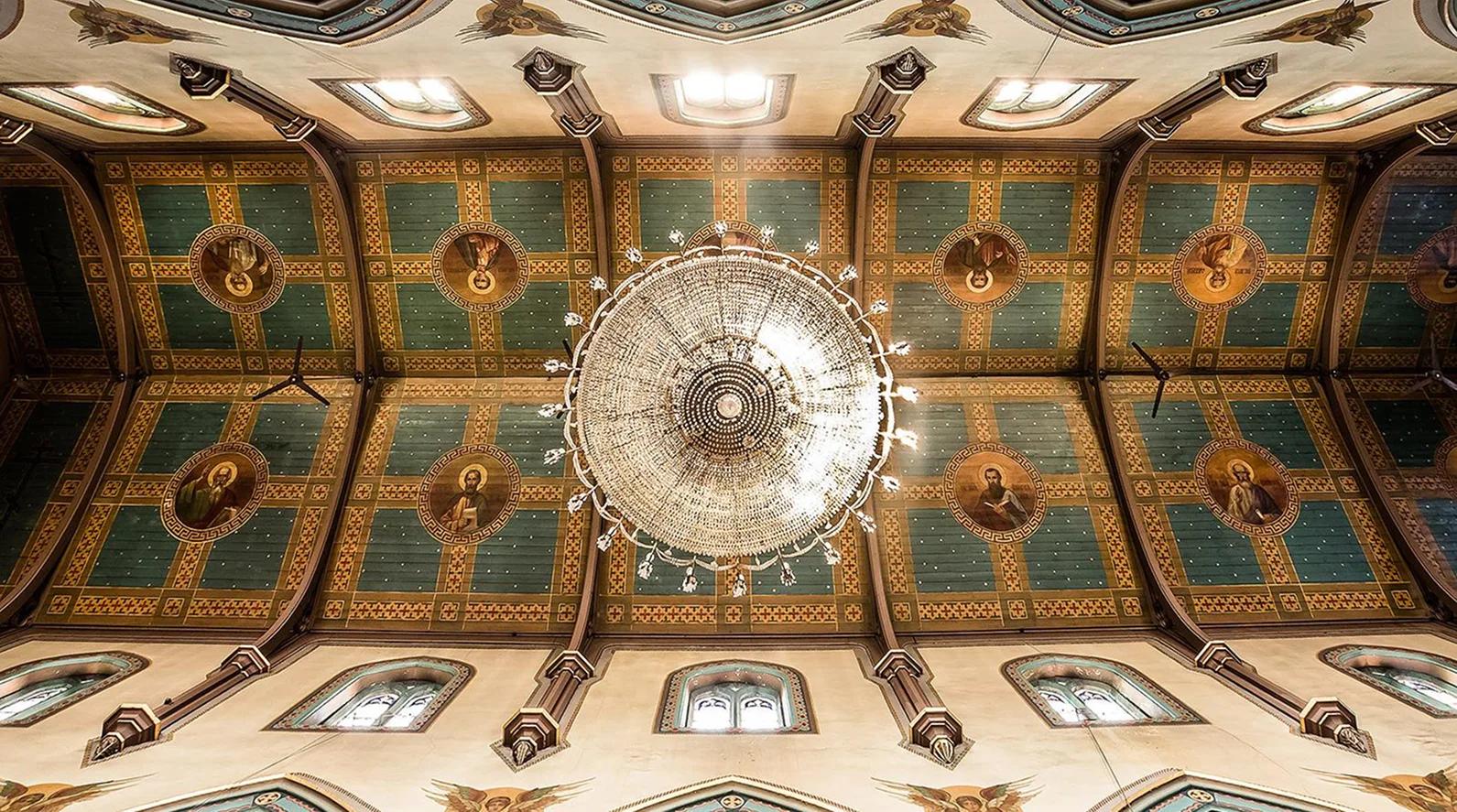
The 45,000-crystal chandelier, funded by the entire congregation, runs the length of the center aisle.
During the same period, three church bells were installed in the towers, donated by parish members and sounding the musical notes A, C-sharp, and E. The great center chandelier, containing over 45,000 pieces of Czechoslovakian crystal, was funded by the entire congregation together. Smaller chandeliers of matching design illuminate the side aisles. The well-worn dark wood pews, still in place today, remain from the original Dutch Reformed Church. Father Adamiak died in active service in December 1940, age fifty-one, with the parish debt reduced to $11,000.
His successor, Very Rev. Michael G. Dziama, held both a law degree and priestly rank, serving as Legal Advisor to the Metropolitan Council of the Russian Orthodox Church in America. He arrived in February 1941 and made short work of what remained: on a Sunday in May 1943, the mortgage was burned ceremonially in the church hall before the entire congregation. Father Dziama died in office on September 5, 1944, at forty-nine. His daughter later endowed the Very Rev. Michael and Matushka Anna Dziama Scholarship Fund at Saint Vladimir's Orthodox Theological Seminary, where it supports the training of Orthodox clergy still.
A Long Stability, 1944–1991
Archpriest John Skvir served from 1952 to 1987, the longest rectorship in the parish's history at thirty-five years. His tenure encompassed the granting of autocephaly to the Orthodox Church in America in 1970, the moment when the North American Church received full canonical self-governance from the Moscow Patriarchate, fulfilling the vision that men like Nemolovsky had worked toward decades before. The acquisition of additional properties on Grand Street, including the purchase of the vacant lot at 101 Grand Street from the City of Jersey City, took place during this era of stability and growth.
The church's physical presence on Grand Street continued to deepen. In 1960, the present rectory at 107 Grand Street, designed by architect Maurice Kraut, replaced the 1916 structure. In 1965, teak doors with a carved Orthodox cross were imported from Hong Kong and installed at the main entrance, their warm wood joining the sandstone facade and copper domes as part of what this building had become. The original Gothic arches and poured-cement columns remained inside, framing the murals and the chandelier exactly as Adamiak and Bodasiuk had arranged them.
Restoration, the Centennial, and Elevation, 1991–2022

Clergy and altar servers assembled at Saints Peter & Paul Cathedral for a hierarchical Divine Liturgy.
Archpriest Joseph Lickwar served from 1991 to 2023, thirty-two years during which the building underwent its most substantial restoration since Adamiak's era. The parish received matching grants from the New Jersey Historic Trust for a three-phase, $1.1 million restoration from 2000 to 2006, returning the church to its 1924 appearance in time for the centennial in 2007. Father Lickwar's description of the church, written for the Jersey City Landmarks Conservancy's 2004 volume, captures what anyone who enters for the first time will sense: a space built for a different order of attention.
The centennial year's conclusion was marked in stone and gold: in 2009, the parish's name was installed in gold letters across the sandstone facade. Archbishop Michael was consecrated here in 2010 and elevated the church to a cathedral in 2020, making it the third OCA cathedral in the diocese, alongside Holy Protection in Downtown Manhattan and Holy Transfiguration in Brooklyn.
Present Chapter, 2023–

Fr. Solomon Longo, assigned as rector in 2023.
Father Solomon Longo arrived at Saints Peter and Paul in 2023 as the parish neared its 120th anniversary. His installation coincides with a slowly rising tide in awareness of Orthodox Christianity among Americans.
Sunday Liturgy at 9:30. Great Vespers on Saturday evenings. Catechesis or Bible Study on Wednesdays at 8pm. The daily rhythm of prayer has continued on this corner of Grand Street since October 24, 1907. Our predecessors have given us many gifts through their faithfulness to God, and we hope to live with similar faith in this present chapter.
The complete record of every priest who has served this parish, from St. Alexander Hotovitsky in 1907 through Fr. Solomon Longo today, is available on the Our Rectors page.
A closer look at the sacred spaces within Saints Peter & Paul. Click any image to open the full slideshow.
- "90th Anniversary; Saints Peter and Paul Orthodox Church, 1907–1977."
- "110th Anniversary: Saint Peter and Paul Orthodox Church, Jersey City, NJ, 1907–2017."
- "A Church's Anniversary; Semi-Centennial of the First Reformed Church in Jersey City." New York Times, 16 February 1880.
- Deyrup, Marta M. "Eastern Orthodox Church." In Lurie & Mappen, eds. Encyclopedia of New Jersey. Rutgers University Press, 2004.
- Gomez, John. "An Overflowing Bounty of Beauty." Jersey Journal, 17 January 2007.
- "Grand Street Reformed Church Sold." Jersey Journal, 15 January 1909.
- Lickwar, Rev. Joseph. "Saints Peter and Paul Russian Orthodox Church." Jersey City's Sacred Spaces. Jersey City Landmarks Conservancy, 2004.
- "New Jersey: Church Dedication." New York Times, 9 April 1857.
- New Jersey Historic Trust. "Saints Peter and Paul Orthodox Church." njht.org
- Park, Michael Y. "Orthodox Church Marks 90 Years Tomorrow." Jersey Journal, 11 October 1997.
- Petrick, Barbara Burns. Church and School in the Immigrant City: A Social History of Public Education in Jersey City, 1840–1930. The Upland Press, 2000.
- "The First Reformed Dutch Church." New York Times, 11 July 1856.